0 Me and Jim
ME AND JIM
As the van pulled into the parking lot next at the Church Key, I realized we weren’t the only band there at one o’clock in the afternoon. We had driven from Chicago to Madison to play a weekend at a happening bar and we thought we’d unload our equipment and set up before settling in at the Motel 6.
The other band was loading out from the night before; it must have been some night. Three scruffy, bleary eyed guys carried drums, amps and instruments out to a Chevy Suburban. They looked like your average over-cooked, over-served, under-loved players that inhabited the college bar circuit that we were trying our damnedest to break into. It was the last guy standing on the steps who was cut a little different. He had to be the leader. He was definitely the star.
The first thing I noticed about him was his elegantly rumpled cowboy hat, mirrored shades and big shit-eating grin. I then noticed that he had a strawberry milk shake in one hand and beer in the other; he was drinking a road frosty at one in the afternoon. Cool. But what really grabbed my attention was the picture of a beautiful naked woman laminated on his belt buckle. No wonder the man was grinning. This was my introduction to Jim Schwall, stellar blues guitarist, electric mandolin player, singer, songwriter and true American original.
We didn’t get a chance to do more than exchange “howdy’s” that afternoon, but we ran into each other a couple times over the next year. We were all paying dues for the same fraternity; “road dogs” trying to make ends meet, chasing a record deal and playing the funky college towns throughout the Midwest. My band, Cactus Jack, playing one-nighters on the way to and from weekend stands made leaving town for a couple of a weeks at a time pay off. For the Jim Schwall Band, being on the road was life, and they had been doing it for years.
In 1977, when our first meeting took place, Jim and his band were the top of that heap. They drew packed houses and had that rare knack for getting the party started wherever they went. Part of their secret was also part of the trap that being on the road sets for those who follow that life: they partied at least as hard as the people they were playing for. This earns you a lot of friends, but can wreck the hell out of your relationships, ravage your liver, and decidedly dull your edge. Jim had been a Chicago kid, and had built his reputation as a Chicago blues-man recording with the Siegel-Schwall Band, but I found out from talking to the guys in the band that they now maintained their home base in Madison. Jim had an actual residence there; the other guys proved the truth in the old joke: what do you call a bass player who doesn’t have a girlfriend? Homeless.
We all finally got to spend some time together in Spring of 1979, at the Florida State Fair. Cactus Jack had played the Illinois State Fair, and we knew that these gigs could be, well, peculiar. Bands like ours were there to entertain beer drinkers, in the designated (and often fenced-in) beer drinking areas. The beer tents in Tampa were giant geodesic domes, with the stages on top of the beer coolers, behind the bar, a good fifteen to twenty feet above the audience. Once you hauled your pedal steel guitars and amps up there, you were set for ten days, so it was no big deal. Bands played three hour shifts and we were on from noon until three. This gave us plenty of time to get some sun, check out the other acts, and generally make mischief.
Jim was booked at an actual “musical venue”, which meant he didn’t have to climb the ladder to reach his stage. He was playing with a singer-guitarist named Al Jolly. When I asked him what happened to his band, he told me that he had stayed sober one night and realized they weren’t as good as he thought they were. He had broken up the band and joined the Jolly Brothers Band, out of Kansas City, who had lost their guitar player after releasing their first album (that always seemed to be the way things happened). Jim being available seemed like Kismet. Our manager, Al Curtis, who booked the fair, had booked them there right before the Jollys had broken up, so Jim and Al agreed to cover the dates. Jim and Al were great together; very musical and very entertaining. Al Jolly is one of the most soulful singers I have ever heard. He writes great songs and his style complimented Jim’s exceptionally well. We spent a lot of time together, hanging out, playing guitars, and talking music over the run of the fair.
The crowning night of the fair came when the young guy who ran the live oyster bar outside our beer dome asked Jim for a guitar lesson in exchange for some oysters. It seemed his father owned one of the best oyster bars in Tampa, and he had the run of the place. He invited us over, after the restaurant closed, for oysters, beer, wine and music. So Cactus Jack, Jim Schwall, Al Jolly, wives, girlfriends and guitars headed out for what we expected would be a couple dozen oysters and few beers. We got to the restaurant and found the young owner and two other shuckers ready to work. The oysters were fresh and cold and kept on coming. We washed them down with pitchers of beer and wine, ate and played long into the night.
When we got back to the hotel, I was pretty much ready to fall out, but Jim had another idea. He had a bottle of Jim Beam and a couple songs we hadn’t played yet. The last thing I remembered was an empty bottle, some Hank Williams and the vow that we would play in a band together someday. I had no idea at the time that by the following Spring we’d be rehearsing the band that would become Cahoots. Oh yeah, the woman on Jim’s belt buckle? It was his ex-wife.
Yours Truly,
Jim
1 Bonaparte’s Retweet
It is said that all rivers run into the sea, which serves as a fine metaphor for the connectedness of seemingly disparate things in this world. My world contains realms of thought that are political, musical, educational, historical, and etc. that don’t always seem to meet, much less, overlap. It is always fun, then, when I find evidence that things we keep in entirely separated mental boxes can, at times, leak into one another.
I have been reading a wonderful book called “The Beautiful Music All Around Us” by Stephen Wade, a banjo player, playwright and musicologist. In it, he investigates the stories behind original field recordings of songs that were collected for the Library of Congress. Many of these songs were examples of regional music that found their way into the popular culture after being nearly lost. One of the songs he discusses is a fiddle tune called “Bonaparte’s Retreat”. He goes back to search out the origins of the version by Bill Stepp, whose recording became the basis for Aaron Copeland’s classical music piece, “Rodeo”, and which later became ubiquitous when used as the background for an ad campaign by the Beef Industry (Beef. It’s what’s for dinner). Here is what Mr. Wade says about this how Napoleon became a central figure in American vernacular music:
“Napoleon Bonaparte’s career fired the imagination of nineteenth-century America, an impression expressing itself in songs, set pieces, and marches wherever local militia drilled to the fife and drum. From ‘Napoleon Crossing the Rhine’ to ‘Bonaparte’s Retreat from Moscow’, a profusion of tunes and titles has traced the peregrinations of the French leader…Even in the era of the internet, traditional histories continue to circulate in cyberspace, commenting on Napoleon and the music he inspired.”
Interesting. But what really captured my attention, at a time when fake news and “alternative facts” have been so large a part of the public political discussion, was the next paragraph:
“The most famous of these accounts concerns Uncle John, a fiddler at Pine Mountain, Kentucky. After running through a few tunes for an inquiring college professor, the old-timer launched into his favorite. Taken with the beguiling melody, the scholar asked the grizzled musician for its title. The mountaineer answered, ‘That one’s called ‘Napoleon Crossing the Rockies.’ ‘Mindful of his duty to the truth, the professor diplomatically averred, ‘That was a lovely tune, Uncle John, and I’m terribly grateful that you played it for me, but you do know that Napoleon never actually crossed the Rockies.’ After a moment’s reflection the musician replied, ‘Well, historians differ.’ “
It appears that Napoleon career is somehow connected to the origins of alternative news. I guess there are some things on which we will simply have to agree to disagree.
0 The Neon Rainbow
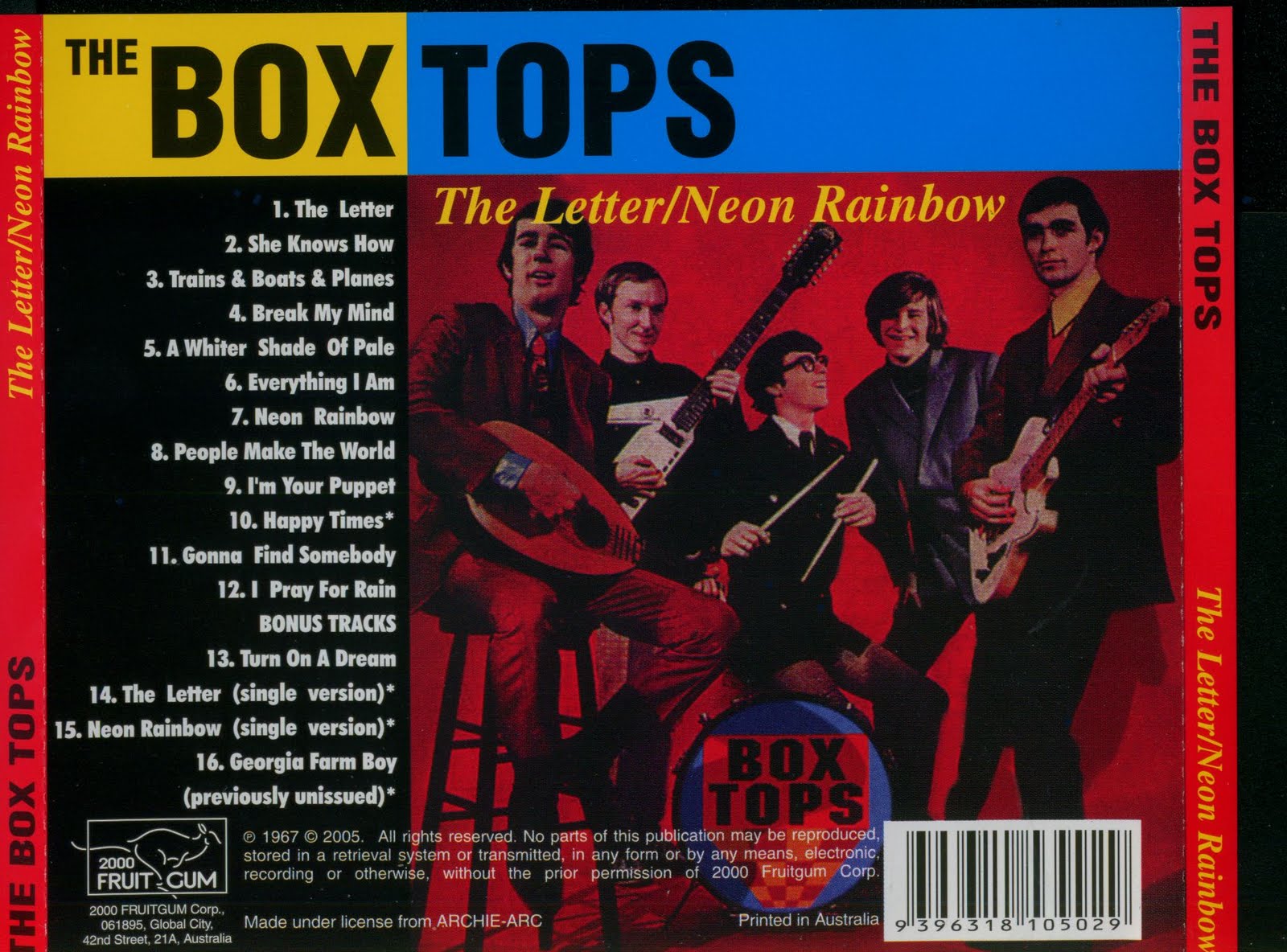
This morning I caught myself singing the first verse to an old Box Tops’ song, “Neon Rainbow”, for absolutely no reason at all. “City lights, pretty lights, they can warm the coldest nights”. I hadn’t heard the song recently, and it isn’t on the list of my favorite songs, but there it was dancing in my head, like a leftover sugarplum. That is the power of a well-crafted pop song: it sticks in some corner of your brain and leaps out at you when you least expect it. Usually, it’s the chorus that you remember (that’s why they call it “the hook”) and since this song had a verse as memorable as some choruses I had to do some investigating. I wanted to know where this delight came from. Who was the songwriter? I expected it to be either Alex Chilton, the 16 year old boy-genius who was lead singer for the Box Tops and later became a mythological rocker with the band Big Star, or Dan Penn, the brilliant singer and songwriter who produced the Box Tops’ album. I was surprised to see that the writer was someone I had never heard of, a guy named Wayne Carson Thompson. I took a closer look at his body of work and found myself asking: How had I missed this guy?
Wayne Carson (he dropped the “Thompson”, his real surname, at some point during his long career) was a GREAT songwriter. He was not just a “successful” writer or an “accomplished” writer; he was a master of his craft. Wayne Carson wrote great pop and country songs that were recorded by a lot of people, over a long period of time. For the Box Tops, he wrote “The Letter” and my personal favorite, “Soul Deep”, in addition to “Neon Rainbow” and other less well known songs on their early albums. His pop songs were recorded by acts as varied as Petula Clark and Tina Turner, and his Country songs were hits, some BIG HITS, for major artists: Conway Twitty, Ray Price, Mel Tillis, Genn Campbell, B.J. Thomas and Johnny Paycheck. Songs that I hadn’t heard in years were instantly brought back to mind merely by reading their provocative and memorable titles: “I See the Want To In Your Eyes” and “Slide Off Your Satin Sheets”. Well-written, extremely listenable pop music. Sweet.
My big surprise was that he had written songs that had been hits for one of my favorite country/slash/outlaw artists, Gary Stewart. I had covered “Drinkin’ Thing” and “She’s Actin’ Single (I’m Drinkin’ Doubles)” with my country bands in the late 70’s and early 80’s, and they are still among my faves. If he had never written another song, these would have established a legacy that any aspiring writer would be proud to claim. But there is one song that truly guaranteed Wayne Carson’s place in anyone’s songwriting Hall of Fame: “You Were Always On My Mind”. First recorded by Elvis, and then performed by just about everybody, this song won the 1983 Grammy for Song of the Year and Best Country Song. Since then it has become Willie Nelson’s signature song and one of America’s most unavoidable earworms. And he wrote it in ten minutes at his kitchen table. That, my friends, is some good songwriting.
Wayne Carson didn’t think the Box Tops’ first record was that good. He didn’t really care for the singer’s voice and he thought that the single, “The Letter”, was too short. He also wondered what the producer was thinking, sticking that jet noise on at the end. Pretty typical response for a songwriter. He wouldn’t recognize a hit song even if he wrote it. Wayne Carson passed away on July 20, 2015 at the age of 72 of natural causes, but his songs still pop into people’s minds when they don’t expect it. And I will guarantee you that tonight, someone, somewhere will be playing a Wayne Carson song and the audience will sing along, blissfully unaware of the name, or story, of the guy who blended the beautiful melody with the clever words. They might remember who recorded it, but that’s about as far as the “whose song was that” game goes. That’s just the way it is for songwriters, most of the time. And that’s OK. But today I want to say thank you, Mr. Wayne Carson, songwriter, for leaving us such a fine bunch of tunes.
0 If I had My Way…Finding Bear River
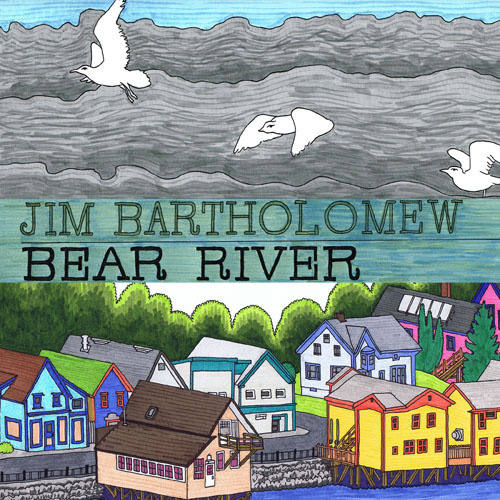
Every song has a story…Purchase this CD at http://jimbartholomewmusic.bigcartel.com/
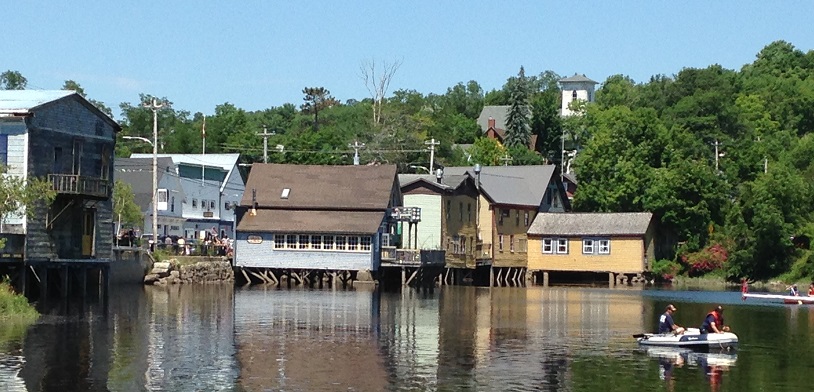
Bear River is the name of the CD that I recorded with my son, Will, producing and released in July. The title comes from the opening cut on the CD, Rendezvous (Bear River Song), which got its inspiration from the little town of Bear River, Nova Scotia. I had never been within a thousand miles of Nova Scotia when I wrote the song, but now that I have experienced Bear River first-hand, I am happy to say that the song and the town seem to fit well together. I don’t think that’s an accident. Bear River, the song, is at heart a 60’s folk song; Bear River, the town, is inhabited by 60’s folk. The fit was pretty natural. By “60’s folk song”, I mean a “folk-like” song, i.e. a song with a story behind it, written not by the anonymous “folk”, but by a singer-songwriter. The story behind Rendezvous (the Bear River Song), the folk-like song, begins with my Uncle Dennis…
In 1958, I didn’t know much about anything; I was eight years old and kids back then didn’t pop out of the box as sharp as they are now. At least, that’s my excuse and I’m sticking with it. My Uncle Dennis, on the other hand, knew a lot about many things. He lived one story below us with my maternal Grandparents in a brick two-flat on Winchester Street, in Chicago. My family then consisted of my Mom and Dad, my sisters Karen and Sue, and my younger brother Dave. Dennis was like an older brother. He showed me how to build model cars, battleships and airplanes from plastic kits that looked just like the real thing. He introduced me to great literature by letting me read his Classics Illustrated comic books. Once, on a family vacation, he shot me in the eye with an arrow (it was probably my fault). He played the glockenspiel in the Weber High School Marching Band at football games played at Hanson Park Stadium; after he graduated from Weber, the band was invited to march in Washington D.C., in President Kennedy’s inaugural parade. Dennis let me tag along when he registered to attend DePaul University where he joined the ROTC and got to wear a red beret. He was a man of many parts, who studied Greek, taught Latin and Geometry, loved to read Science Fiction and had the greatest collection of belt buckles you could find anywhere. And, oh yes, he gifted me with his sense of humor. One critically important thing he did for me was turn me on to MUSIC.
My whole famn damily was musical and when I was little many family parties ended with me drifting off to sleep under a kitchen table, listening to the sounds of polka music, pinochle and laughter. But Dennis had a way of finding music that was new and different and weird and funny. He introduced me to Stan Getz playing jazz in 5/4 time, South American guitar sambas (the Girl from Ipanema), and even some rock and roll (Ricky Nelson!). Thanks to Dennis, I heard Rolf Harris play the didgeridoo while he watched the “sun a-rise” and tied his kangaroo down, I learned what Allen Sherman told his Muddah and Faddah about life at camp Granada and, thanks to the Smothers Brothers, why you should yell ”fire” if you fall into a vat of chocolate (nobody will help you if you yell “chocolate”). I was also introduced to the “cows-mopolitan” song parodies of Homer and Jethro, “Live at the Country Club”. Many years later, when Ted Douglas and I started playing our own brand of “good-time folk and country music” on the Chicago folk circuit, I “borrowed” liberally from these records and actually got to play some dates with the great mandolinist, Jethro Burns.
The albums Dennis bought with the money he earned working at the Wieboldt’s on Milwaukee Avenue were spun on a beautiful blonde console stereo phonograph in the basement rec room of the Winchester house. That’s where I first heard, and learned to love, the folk music of the 1960’s folk revival. At first, I became aware of just a few songs heard on the car radio or on the Wally Phillips Show on WGN, like “Don’t Let the Rain Come Down” and “Green, Green”. Then came the Kingston Trio. Their first album was earth-shattering; it was followed quickly by “Live at the Hungry i”. The music was exciting and funny, melodic and memorable; I learned every song and can still sing them, word for word, today. Before long Dennis introduced us to albums by Peter, Paul and Mary, the Clancy Brothers with Tommy Makem, Harry Belafonte, the Chad Mitchell Trio – the list is as ageless as it was endless. Along with the musical groups Dennis found some amazing comedians like Bob Newhart, Mort Sahl, Bill Dana and a pre-Mayberry Andy Griffith. We absorbed them all, even Bill Cosby, so funny then, who would prove to be so weird and disappointing later. This was the start of my love affair with record albums, a love affair that hasn’t abated to this day.
Years later, after we moved to the ‘burbs, and Dennis and his bride, my Aunt Adelyne, became occupied with raising my cousins Jeff and Jennifer, I continued to follow where the music led. The Beatles, Beach Boys, Bob Dylan, and the Byrds seemed like natural steps in a progression that began in that Chicago basement. Although I found new musical heroes, I never quit listening to the folkies or looking for their albums at second-hand record stores. Dennis and I were always close and he remained a great source of humor and support as my life wound on. Dennis loved history, particularly American History, and he would often vacation with his family at places like Cahokia Mounds, in southern Illinois (and mounds they are; little piles of pre-historically important dirt. You can imagine how the impressed the kids were). When we were much younger, we had walked the fields of my Grandpa’s farm in Southern Illinois, looking for arrowheads and other Native artifacts that got churned up when the farmers plowed. We found quite a few.
After he retired, Dennis would attend Mountain Man “Rendezvous” that were held throughout the Midwest; reenactments of the old-time fur trapper gatherings that featured authentic clothing and skills competitions like in days gone by. He would use leather, beads and feathers purchased at these Rendezvous to fashion medicine pouches which were given to nieces, nephews and other family members on their birthdays, along with the identity of their spirit animal. It was a beautiful way for Dennis to share the spiritual connection he felt between his family, this land, and its original people. It was a terrible shock when Colleen and I returned from a short trip to St. Paul, to learn that Dennis had suffered a major stroke and was in a coma from which he would not awaken. With his passing I lost much more than an uncle. I lost a mentor and a friend. I lost a source of who I was.
At Dennis’ wake, Adelyne asked me to sing “Wind Beneath My Wings”, which I gladly learned. After I finished, I decided to sing “Wahoo”, an old cowboy song that was one of Dennis’ favorites and that I had sung innumerable times with my band, Cactus Jack. Everyone sang along and the sadness lifted a little. Dennis would have liked that. Later on, as I sat with Colleen and her sister, Kari, and Kari’s husband Kevin, in our car positioned behind the silver Cadillac hearse, we talked as we waited for the procession to the cemetery. Kari and Kevin had come from St. Paul to pay their respects on their way to their second home, a little white house on the banks of the Bear River, in the Nova Scotia town with the same name. We had heard a lot about Bear River when last we saw them, and as they described what awaited them at the end of their journey, both Colleen and I expressed the wish that we were going there with them. It suddenly occurred to me that Dennis, with his love for lesser-tamed places and a simpler way of life, would probably have wanted to join us. After that, the song practically wrote itself.
I wrote the first verse of the song in his voice. It was only fair. He had done so much to help me find mine.
0 Happy Birthday Monterey Pop
Forty-eight years ago today, if you were lucky enough, and hip enough, you had the opportunity to hear the sounds of a world changing. June 18, 1967 marked the opening of the Monterey Pop Festival – a three days concert extravaganza that introduced the American pop music world to Jimi Hendrix, Janis Joplin, Ravi Shankar, the Steve Miller Band, the Electric Flag, Otis Redding and the Who. With a lineup that included established acts like Simon & Garfunkel, the Buffalo Springfield, the Byrds, the Mamas & Papas, the Paul Butterfield Blues Band and many more, Monterey Pop was the first of the great Rock Music Festivals. It ushered in the Summer of Love and, in a way, signaled the opening of the Pandora’s Box that was the Hippie Counterculture. It was the dawning of the Age of Aquarius.
These days, the standard reaction to any mention of “Hippies” runs along the lines of “thank God we outgrew THAT”. I think that this is a damn shame. Like so many things that get swept up into popular culture, the ideas and ideals that gave rise to the counterculture were misrepresented, misunderstood, and eventually subverted by their brief period in the pop-culture spotlight. With the focus placed on the most sensational (and aberrant) aspects of what at heart was an attempt to find a more self-sustaining, satisfying, fulfilling and peaceful way to live, it was inevitable that the pro-social and spiritual subtleties of the movement would get lost in a haze of bong smoke and patchouli oil. But – like it or not – the world changed, and it will never be the same place that it was again.
Unfortunately, that change came with a dark side and the progression down the inevitable road to ruin can be seen clearly if you trace the arc of the big rock festivals of the era. Monterey was rooted in cooperation (the group that staged the festival was truly groovy) and musical exploration. Woodstock was all sensationalism and spectacle, washed down in torrential rain and bad acid. Finally, we reached Altamont Speedway, where the Stones provided an appropriate soundtrack to the sudden descent into chaos and death that mirrored both our foreign policy and the government’s determined counter-revolutionary attitude.
I will talk more about the revolution and counter-revolution that I experienced in the late sixties and early seventies, and the effects of which I see around me on a daily basis, at another time. With another election coming up, I feel it is important to reflect on the things that have contributed to the world as it is today. But for now, I want to celebrate that brief moment at the very beginning of time (I was 16 and it seemed like the world was just being born) when anything was possible, when the most improbable things were happening all around us (Hendrix? Really?), and when it was still safe to think out loud about how much better this country could be IF ONLY we stopped worrying about our stuff and got our shit together. Monterey celebrated diversity in thought by presenting and celebrating diversity in music. This is something that is worth celebrating; even more than a Stanley Cup. So: Hooray! Monterey!
0 How Billy Came To Chicago
How Billy Came To Chicago
It was Autumn of 1976. Cactus Jack was in the middle of a week at a dive known as McClelland’s, on the waterfront in Quincy, Illinois, and things were getting desperate. We had lost our second drummer and were learning the truth behind Linda Ronstadt’s quip that if she could find a drummer who could play a country shuffle AND rock, she’d marry him. Before we left Chicago, we had gotten to the point where we’d take any drummer who could play time and knew who Merle Haggard was. Dave, the drummer who survived the latest auditions, said that he knew who Merle was, but we were beginning to have our doubts.
Angie Varias, our departing stick handler, had been more than a good drummer; his vision of how a country rock band should look, sound and present itself, both on stage and in the studio had forced the band to grow up. His drive had helped us build a fan base in Chicago and the northern suburbs, but for some reason, things just refused to gel. We weren’t living up to his expectations, and no one was happy. One night, after a blow-up at our bread-and-butter gig at Durty Nellie’s, Angie walked out, and we let him. As good as Angie was, we figured we’d be better off without him. Little did we know…
Our first option was a Nashville drummer named Richard Furman, who we had hung out with when we played the Illinois State Fair, where he was playing with a singer named Wyatt Webb. We had a shared interest in outlaw country and when we called him up, he agreed to meet us in Carbondale to cover three nights and “check the fit”. After a couple hours of rehearsal in our hotel room, Richard was right on the money. This was gonna be easy! Unfortunately, we’d only seen Richard in beer tents and hotel lounges, which turned out to be his natural habitat. He lived for the party, and we were a little too serious and way too broke to fit his life-style. We headed back to Chicago with a bill for a trashed hotel room and no drummer.
We began auditioning local drummers when we got back to the city. We called every contact we had and followed every lead, but when we found someone who could actually PLAY, there were always “complications” (making short money always complicates things).When Angelo quit, I had written in my journal: “We need someone good who’s willing to become committed to our situation, and this will not be easy. We still can’t promise anyone any kind of a gravy train. We’re still just a group with a little past, a lot of future, and a mediocre present.” That pretty much summed things up. We had taken the best guy we found to Quincy, thinking we could “educate” him in the boondocks; by Friday we knew it just wasn’t gonna happen. And we were returning to Durty Nellies on Wednesday.
Quincy is a beautiful town, off the beaten track in downstate Illinois, right across the Mississippi River from Iowa. It was also the hometown for our lead guitarist, Ric Winking. That Saturday afternoon, we had our Steel player, Steve, take Dave to the movies while Ric, Mike Kueffer (our bass player) and I met at Ric’s parent’s house to figure out what we were going to do. We had little time to find someone, much less rehearse, but we had little choice. At one point, while we were commiserating, one of Ric’s brothers mentioned that a drummer that they had played with a while back was back in “the area” (in this case, “the area” meant Keokuk, Iowa, forty miles as the crow flies), living at home and driving a forklift in a warehouse. It was a complete shot in the dark, but Ric said the guy was good and we were desperate. What the hell, Bubba, call him up!
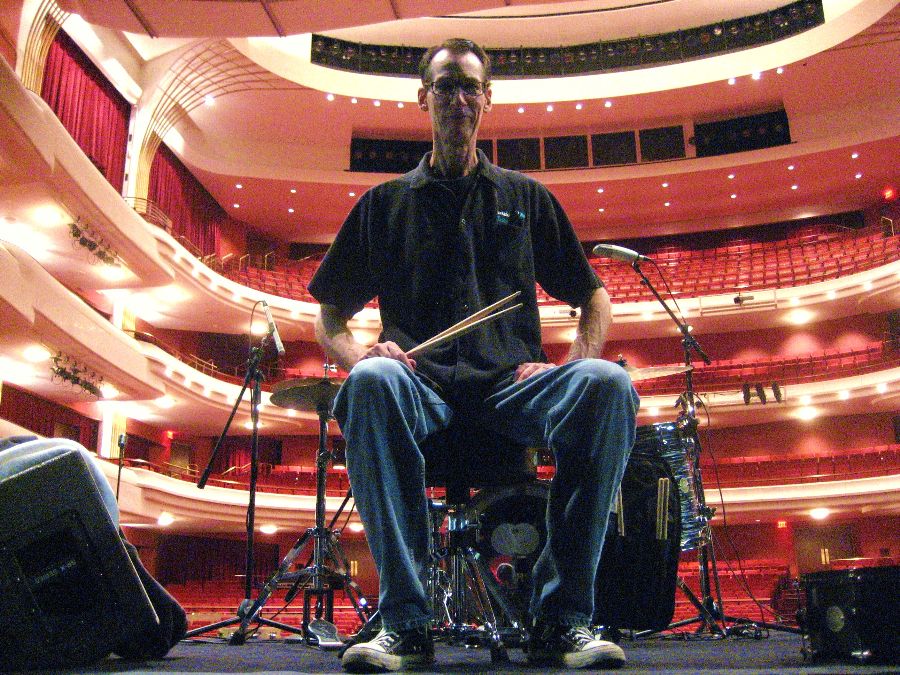
Luckily, Billy Shaffer was home when Ric called. He had just moved back from Las Vegas, where he had spent about a year playing in a Casino with an organist and bass player. The gig had called for him to play all styles of music, from jazz, to show tunes, as well as pop and rock. When the gig ended, he had moved home while waiting for a call from the organist about what was going to happen next. After a few minutes of catching up, Ric explained to Billy what we were doing, what we were looking for, and what we could offer. Something about it must have sounded interesting, or else Keokuk is just that boring a town. Either way, Billy said “sure” and agreed to come back to Chicago with us after the gig that night.
We were elated; we didn’t even care about an audition. The only problem left was finding a way to explain things to Dave…That unwelcome chore fell to me, but was a lot less noxious than I thought it would be. It turned out that Dave was as unhappy as we were. He was not used to the kind of pressure our music placed on him and it was making him a nervous wreck. We all rode back to Chicago in our green Econoline Van, Dave and I talking as I drove, and the other guys crashed out on the amps in the back.
Billy camped at Ric’s (same as Ric had stayed with me and my wife Colleen, when he moved to Chicago) and we finally got to hear him play on Monday. We set up at Nellie’s and rehearsed twice before our Wednesday opening. He got it immediately. It didn’t matter what we threw at him, he remembered the arrangement after one run-through. He played all the kicks and came out of them without missing a beat. He was the smoothest drummer I had ever heard; he could rock and he could swing. I reminded myself never to introduce him to Linda Ronstadt. In addition to that, he was as solid a human being as I had met in the music business. He was utterly dependable, behind the drums or behind the wheel of the van. Where many musicians lived from bar to bar, Billy would rather read philosophy or play pool, at which he was UNCANNY. He could play chess and carry on a conversation. He was funny and he had great musical ideas and he played well with others. With Billy on board, Cactus Jack was ready to become what we had been billing ourselves as: The Sound of Chicago Country!
After Cactus Jack broke up, Billy joined The Jump ‘n the Saddle Band and became a solid rhythmic force with that popular Chicago band. I was lucky enough to get him to rejoin me and Curtis Bachman (who had been the bass player in the last months of Cactus Jack) in our new venture, Cahoots. With Jim Schwall on lead guitar and mandolin, Willie Wainwright on fiddle, and Cary Donham on keyboards, Cahoots was as fine a country (and rock, and blues) band as Chicago has seen and heard. Since its demise in 1982, Billy has expanded his reputation as a go-to guy whether on stage or in the studio, by playing and recording with some of the best musicians in the city, and nationally. His most recent regular gig, anchoring the touring band in the Million Dollar Quartet, has shown the rest of the country what I knew from the first time I heard him: when it comes to the Big Beat, Billy Shaffer brings it with him every night.
Billy, Jim Schwall, and myself will rejoin forces for one rowdy night, backed by the MojoSkillet on July 6 at the Abbey Pub in Chicago. Join us for the fun!
0 Meeting A Personal Hero
Meeting A Personal Hero
I began my professional music career as a folk singer. I played and sang with bands during and after high school. I was a horn player and vocalist. We never made money, we just played for the fun of playing . Just loud, brassy, swaggering teen aged rock and roll.
But what I really wanted was to sing harmony and play the acoustic guitar. I didn’t know anything about the so-called “folk revival” in 1969, but I had an uncle who did and introduced me to albums by the Clancy Brothers with Tommy Makem, the Kingston Trio and the Chad Mitchell Trio, and I soon found Bob Dylan on my own.
I learned that one of the premier places to hear the kind of music these men played was the Earl of Old Town, and that the Chicago guy to see was the great Bob Gibson.
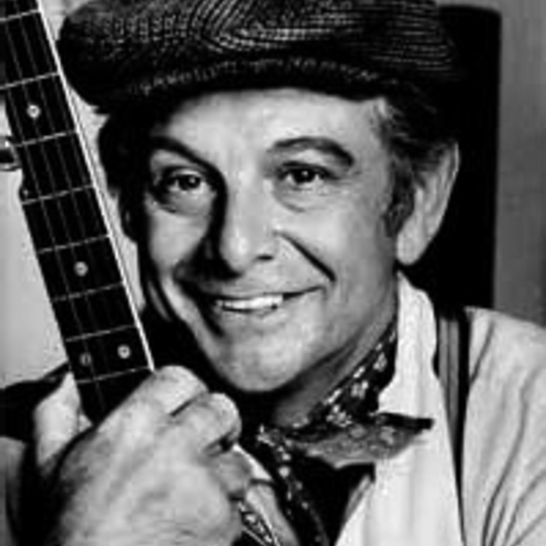
My first year after high school, I was trying to transition from Byrds-like rock to more authentic folk, when I finally had the chance to see Gibson play at the Earl. I had met a friend from high school downtown over Thanksgiving break, and after touring the Art Institute, I asked her if she wanted to grab a burger at a folk club. She said, “sure”, and not having any real sense of distance in the city, we set off walking. Straight up Wells Street, the 40-or-so blocks from the loop to Old Town, Chicago’s answer to the Haight. Did I mention it was November?
When we got to the Earl, we realized that it was well worth the walk. There, on that tiny little stage with the Shure Vocalmaster P.A., was the man himself – Bob Gibson, American folk legend. He was exactly as I had imagined: a man of the people, reminding us to keep our “skillets good and greasy”, and having a heck of a good time.
In addition to a great set by the master, we also got to see and hear for the very first time at the Earl ; “a great new singer-songwriter on the scene, who’s going play a few songs for you”. I had never heard of Steve Goodman, but after that afternoon I wasn’t likely to forget him. Truly, a day tucked away in the back of my mind, pushing me further toward my calling; I was going to be singing my own songs, there, on that stage, someday.
It took some work, but by 1973 I was playing the North side folk clubs in Chicago in an act known locally as “Bartholomew and Douglas with C J Holton”. I played guitar and sang, Teddy Douglas played guitar and banjo and sang, while our friend C J tried his best to keep up with our frantic take on folk and bluegrass on the bass. We were young and brash; we played every open mic and showcase we could find, scored big with the crowd at the Saddle Club, and even did a guest set of our own at the Earl. Eventually, Dan Johnson, who owned a club, Orphans, up on Lincoln Avenue, took a shine to us and we began playing his club regularly, and for real money too.
Orphans was a place where a lot of players would go to hang, have a drink, and catch the show in the back room, and one night, sitting in the back with a couple of friends was Bob Gibson, himself. And he seemed to be enjoying himself.
At the end of the set, I was packing up my Martin when Gibson himself walked up and introduced himself. He said he’d seen us a couple times and liked our harmonies and energy. He said he thought we had a future and introduced one of his buddies, Pete, who was a Record Producer, to us. I was stunned. He said Pete was an independent producer and engineer. Pete had just come to town from Champaign/Urbana, and was looking for some people to work with. “Would you like to record a demo?” Well, hell yes we would, and thank you very much Mister Gibson for the benediction. With that, Bob Gibson walked away and Ted and I sat down and laid our plans with young Pete from Champaign.
Some things simply are not what they seem. Pete had done a solo album down at the U of I, called “Thesis”, which should have been a large tip off to more experienced players. All we knew was that this guy had mics and a reel-to-reel recorder and he would be at Ted’s place on Monday to begin our demo sessions. It would be a location recording, because that would give it a “more natural vibe”, and the location was our place.
Pete was the type who wanted everybody to get comfortable before recording, which required as many beers, as much food, and as much weed as anyone else could provide. We recorded the vocals in the bathroom (“Man, the reverb in there is outrageous”) and managed to crank out five songs before the supplies ran out along with our energy and enthusiasm for the project. At one point, Pete hit the wrong button and erased the three-part vocals on the outro for one of the songs. Ouch! We gave Pete some money and said thanks and that was that. We had a tape. For what it was worth.
It took a few years for me to understand exactly what had gone down between Bob Gibson, Pete the producer, and Bartholomew and Douglas. I think I know now, how it all came about, but I can’t be sure; and with Bob passed on to through those Golden Doors, I’ll never really know.
I can see Pete hitching to Chicago, after finishing his college “Thesis”, looking for a way to get into “the Biz”, and meeting Bob Gibson. He was a big name and a nice man, and probably didn’t have the heart to just say “buzz off” to this enthusiastic young admirer. So he passed Pete on to us. I’m sure he believed he was doing us both a favor. I never got a chance to tell him how the recording turned out. I never saw him at Orphan’s again, as a matter of fact. Funny how that worked out. But I know in my heart that when I saw him listening to our set that night before this goofy business was transacted, he was having a good time. Keep that skillet good and greasy.
Jim
Feb 2013
 jimbartholomewmusic.com