Cactus Jack
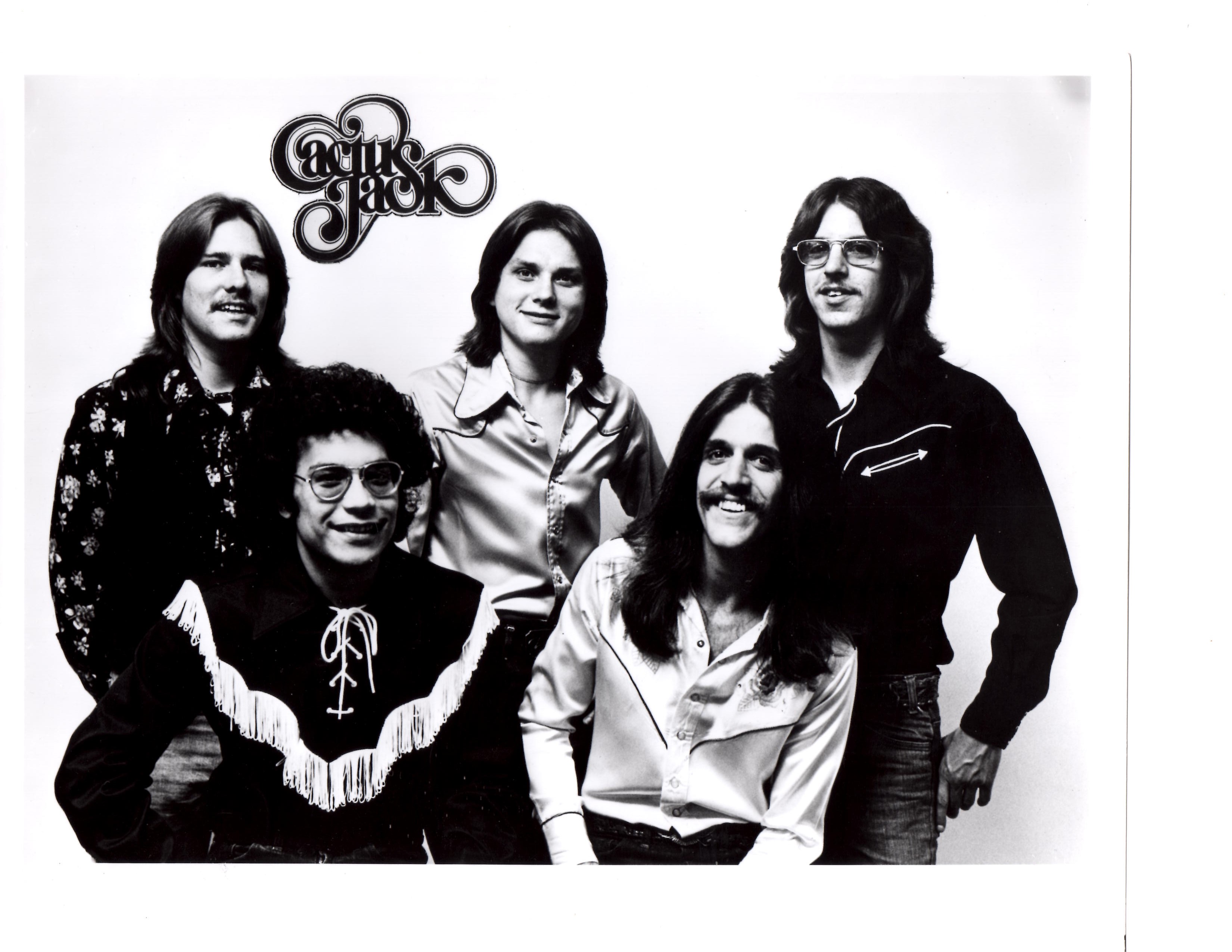
The story goes that Chicago Country/Rock Band Cactus Jack began when two High School friends from the Northwest suburbs, Jim Wisniewski and Ted Douglas, traded their electric guitars for acoustic instruments and began playing College Coffeehouses in the late 1960’s. That’s pretty much true. But to start at the beginning, we need to introduce you to Bartholomew & Douglas w/CJ Holton.
Ted Douglas and I liked a lot of the same kinds of music: traditional folk, bluegrass & acoustic blues. We spent many late-night hours jamming and smoking, which convinced us to combine our efforts and become FOLKSINGERS. We both loved to sing, particularly in harmony. I played finger-style guitar and Ted could flat pick some hot leads, and pick the banjo, and we had a chemistry that produced a sound that was truly infectious. We talked our friend CJ Holton, a really good dude who played harmonica, into playing bass and Bartholomew & Douglas was in business.
Our song selection – songs like “Wolverton Mountain“, “Detroit City“, and lots of Dylan – up-tempo rhythms, and we-don’t-give-a-damn approach to a wide variety of music proved to be very crowd-friendly. Before long we were livening up a lot of folk clubs and open mics around Lincoln Avenue. It was an open-mic set at the Saddle Club, a popular spot for Chicago folkies, that led to an appearance as featured artist for a Sunday Concert at the Old Town School of Folk Music. That show, and another appearance at the Old Town School as the opening act for bluegrass legends, The Osborne Brothers, established B & D as a “rising act” on the Chicago Folk and acoustic country scene. Fortunately, we were too young and naive to realize we were in over our heads.
We rehearsed a lot and began getting some good paying gigs in and around Chicago, and after playing a couple of shows at Juicy John Pinks in DeKalb with the Pleasant Street String Band, we could feel that things were getting serious. It was a little too serious for CJ, so Ted and I enlisted free-spirited Bassist/Singer, Michael Kueffer from the Pleasant Street String Band to take his place and, though it took some work to get him to come around, the promise of actual paying gigs convinced him to sign on. The new trio soon became regulars at The Bulls, Barbarossa, Kingston Mines, Orphans and other Chicago watering holes.
By the mid-1970’s, the folk music club scene in Chicago had begun to change. Except for the pure Irish bars, acoustic bars were either closing or electrifying and it seemed that folk groups were either moving toward light rock, progressive country or the couch in the den. Ted and I always felt like luck was with us (finding Mike just when we needed him seemed like a sign) and two things occurred that would help set the course for our future: we, once again, found like-minded musicians who helped develop and enlarge our sound and we got booked at the perfect bar in which to really get things moving. The bar was Durty Nellie’s Irish Pub in Palatine, and the musicians were drummer/singer, Kirby Bivans, and Jerry Lee Davidson, a truly unique lead electric guitarist/singer/songwriter.
Kirby and Jerry Lee had been playing with the Ron Crick Band at a Chicago club called the Bulls during the same time period Bartholomew & Douglas were appearing there with Mike Kueffer. On one fortuitous occasion, Kirby’s drum kit was still set up from the previous night when we arrived. We were doing a live recording that night and even though Kirby had never seen us play, we asked him if he would like to sit-in. We had seen him with Ron Crick and we knew he was an experienced and well-respected drummer, schooled in country and bluegrass, who also sang. Kirby was a rare diamond in Chicago and the fit was perfect from the start.
At first, Kirby only agreed to sit-in when available at some gigs and it took the opportunity offered by Durty Nellie’s to get him to sign on. Durty Nellie’s at this time was a traditional Irish Pub, featuring almost exclusively acoustic Irish and Folk musicians. It was known for its rowdy and appreciative crowds, multi-night bookings, and fair pay. Bartholomew & Douglas had been semi-regulars there and were encouraged by the owners (a consortium of airline pilots who used the club to cut loose) when we said we were thinking about adding a drummer. The audience response to a fuller country-rock approach was better than expected and soon Nellie’s was Chicago’s premier country rock bar, and the band was playing for weeks at a time to sold-out rooms. It was at Durty Nellies that we settled on a name change and became “Cactus Jack”. It was also there that Kirby’s brother, Scott Bivans, a brilliant graphic artist, drew the iconic logo that solidified the band’s identity, on over-lapping bar napkins.
By this time Ted Douglas had sdropped the banjo and added the pedal steel guitar to his arsenal and would switch from electric lead to pedal steel, depending on the song. After adding Kirby, it felt like we needed a second lead guitarist to complete the band’s sound and we asked Jerry Lee Davidson, an exceptional musician and singer, to join us. Although still young, the Seattle native had traveled and played extensively in Austin, Texas, and he brought a unique playing-style along with a suitcase full of songs by Texas writers that were well-suited to Cactus Jack’s emerging approach. Our sound, rooted in electric bluegrass and country music, featured interesting and original songs as well as traditional country standards, and was put across using four-part harmonies and electric and steel guitar interplay over driving acoustic rhythms. All the elements that could be found at any Cactus Jack show over the next decade were now in place.
It was the energy, humor and originality that Cactus Jack brought to our audience that separated us from other bands exploring country rock in Chicago. Inspired by contemporary artists like Bob Dylan, the Byrds and the Flying Burrito Brothers, we soon built a devoted fan base and following in clubs and concerts throughout the Midwest, particularly in the Chicago suburbs. Playing 200 plus dates per year, Cactus Jack performed at the initial Taste of Chicago on Navy Pier, at WMAQ’s Country Music coming-out party at Comiskey Park, at colleges and community concerts, state and county fairs, and in innumerable country bars. We opened for Fleetwood Mac, The Kingston Trio, Richey Furay, Loretta Lynn, Tom T. Hall and Marty Robbins and backed up such well-known Nashville and Grand Ole Opry artists as Merle Kilgore, Billy Walker and Gene Watson at the Illinois State Fair.
Over the years, membership in the band changed as musicians got restless and followed other opportunities, but the band was always able to turn change into the opportunity to grow. When Kirby Bivans left to follow his Muse, he was first replace by Angelo Varias, a drummer and songwriter who would later go on to play with John Prine’s Band, the famous Potatoes. He was later replaced as a permanent member by Billy “the backbeat” Shaffer. When Cactus Jack disbanded, Billy went on to play with the Jump ‘n the Saddle Band. Following his stint with them, he rejoined me in Cahoots, and finally became a cast member in the hit musical “The Million Dollar Quartet” during its long Chicago run.
Ted Douglas left Cactus Jack to hone his mastery of the steel guitar in Chicago’s honky tonks and would later re-join me in our late 80’s Country band, Silver Spur. Upon leaving Cactus Jack he was replaced as steel man by Steve Sosnowski, A/K/A Steve E. Steel, who excelled with the band until its end in 1980.
Jerry Lee Davidson travelled back to Texas, later to return to help form Chicago legends, the Walter Williams Band. His exit was followed by the addition of singer, songwriter, guitar-slinger and fan favorite, Ric Winking, from Quincy, Illinois. Ric proved to be an excellent collaborator in writing and arranging and played with the band until the very end. A well-schooled musician from a family of musicians, he played guitar for Ernie Sky and the K-Tels in Austin, Texas and, as a member of the Might Big Horns, wrote arrangements for recordings by the K-Tels and for Texas singer Marcia Ball. He currently lives in Missoula, Montana, recording his songs and playing with popular country band, Montana Rose.
The exit of Michael Kueffer in 1979 was the beginning of the end for Cactus Jack. Although he was followed by excellent bass players, his combination of musicianship, vocal ability, songwriting and stage presence and personality was a key to Cactus Jack’s success. For a short time Lee Sherer an excellent keyboard player served as bassist, and when he moved back to Minnesota, the band was lucky enough to enlist a true Chicago legend, Curtis Bachman as bassist/vocalist. Curtis’ was an original member of the Chicago favorites, the Buckinghams, later formed the band Truth (with members of Van Morrison’s original group, Them), and still later joined Chicago favortites, Baraboo before joining Cactus Jack.
Although the story of Cactus Jack ended officially with our disbanding on January 1st of 1980, the musical connections between members continued into the new decade. After a brief retirement from the music scene, I began to toy with the idea of putting together a band that would combine Country, Rock and Blues to further explore the musical terrain that Cactus Jack had begun to map out. The new band would be called Cahoots and would include old faces and new on a new and continuing adventure…
 jimbartholomewmusic.com
Comments